AI Training for Teams · 2026
Make your people better at AI.
92% of leaders say AI makes their people more productive. Only 29% say it’s changed the bottom line.
The tools work. The adoption gap isn’t technology — it’s how people have been taught to use it.
01 / The Missing
63%
Nearly every organisation has AI tools. Most people use them for the obvious things — drafting emails, summarising documents, answering quick questions. That’s the individual productivity gain. It’s real but small.
The larger value — the kind that shows up in budgets and performance reviews — comes when people learn to think with AI, not just type into it. Use it to pressure-test a strategy. Prepare for a negotiation. Redesign a process. Solve a problem they didn’t know had a solution.
That’s not a feature people discover on their own. It takes structured practice with someone who can show them what’s possible — using the same tools they already have.
Research backs this up. Only 21% of organisations that adopt AI have redesigned how their people actually work with it. That 21% is where the ROI lives.
Source: McKinsey State of AI 2025 — workflow redesign stat.
02 / The Room
Here’s what I see in every training room.
Most people aren't bad at AI. They're busy. They have jobs to do, deadlines to hit, and very little headspace to experiment with something that gave them a mediocre answer the first time they tried.
But there's something deeper going on.
When you've spent years getting good at your job, your brain optimises. You develop routines. Shortcuts. Instincts. That's expertise — and it's valuable. But it also means you stop seeing other ways to do things. Not because you're not smart. Because your brain has decided, efficiently, that this is how it's done.
AI disrupts that. Not because it replaces your expertise, but because it asks you to think about your work differently. And that's an uncomfortable ask for someone who's already good at what they do.
So what happens in training is predictable. Someone demonstrates something extraordinary with AI. Half the room thinks: “That's amazing — why didn't I think of that?” And then immediately: “I should have thought of that. What's wrong with me?”
That second reaction is the one that kills learning. The gap between what they just saw and what they can do feels too wide. So they pull back. Protect themselves. Decide it's “not for me” or “not practical for my work.”
My job is to make that gap feel crossable. Not by impressing people with what AI can do — but by starting from where they already are and showing them the next step they can actually take.
03 / The Proof
What the room says.
4.78/5.0
Average participant rating
270+
Participants trained since June 2026
6
Sectors trained
Government · Education · Financial services · Corporate leadership · Tech · Startups
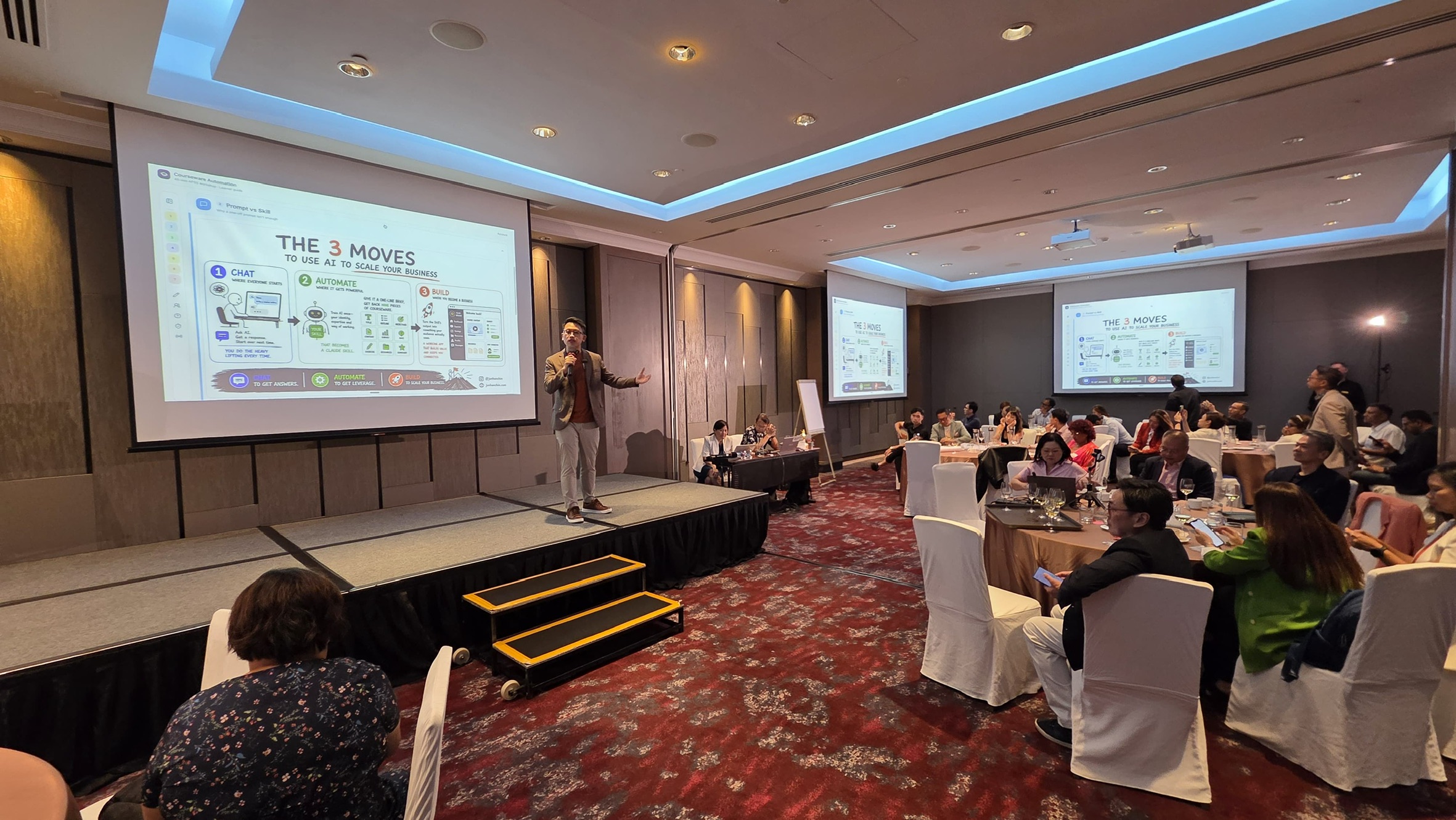
Live keynote — presenting “The 3 Moves to Use AI to Scale Your Business”
One group of educators had already sat through two AI workshops before mine. Nothing stuck. By the end of our day together, three of them had built personalised AI assistants for their own classrooms. But the moment I remember isn’t the tools they built. It’s one teacher who said:
“For the first time, I didn’t feel like AI was something happening to me. It felt like something I could use.”
That shift — from threatened to capable — is what I’m hired to create.
04 / The Approach
How it works.
I teach your people how to think clearly with AI — not what buttons to press, but how to communicate with a tool that only understands what you actually say, not what you mean.
Every session follows the same arc: I explain a concept, demonstrate it live with real examples, then your people practice with tasks from their actual work while I guide the room. By the end, they’ve built something real — not a hypothetical exercise, but an output they can use tomorrow.
The training adapts to the room. Fast groups go deeper into creative applications. Hesitant groups get more space to find their footing. Nobody sits through content that isn’t relevant to them.
No coding. No technical background. Just the tools they already have and a clearer way to think with them.
01
Explain
→02
Demonstrate
→03
Practice
→04
Output
FormatsFrom a focused 90-minute session to multi-day programmes — each adapted to the team’s starting point and goals.
05 / The Person
About Jun Han
I've trained teams across government, education, financial services, and tech — from senior leadership to frontline staff. My sessions consistently rate above 4.7/5.
I don't come from engineering or computer science. I come from communication — I've spent years making complex ideas click for audiences who don't have time for jargon.
That's exactly why this works. I know what it feels like to get garbage from a tool everyone says is revolutionary. I know the frustration of watching someone else do something extraordinary with AI and thinking: “Why can't I do that?” I've been where your team is. I'm just a few steps ahead — using the same tools, figuring it out in real time, and bringing back what works.

06 / The Ask
Let’s talk about your team.
Tell me what you’re dealing with — the size of the group, what they’ve tried before, what’s not working. I’ll tell you honestly whether I can help.
07 / The Follow
Want to learn AI yourself? Follow along.
Practical AI tips — no hype, no jargon.
Something bigger coming soon. Leave your email if you want first access.
© Junhan Chin 2026. All rights reserved.
junhanchin.com